


Pushing the Edges of Comfort

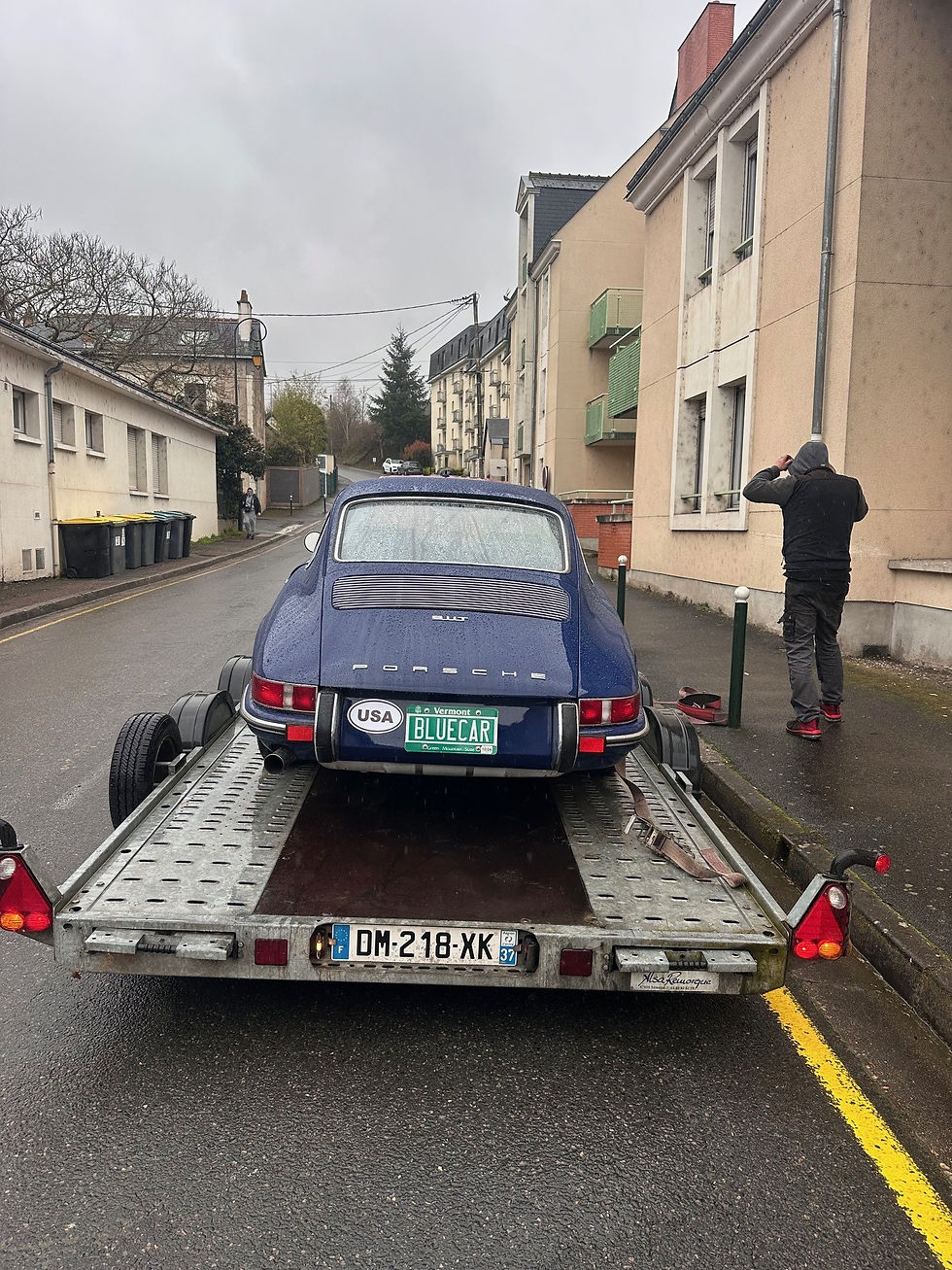
The Blue Car chose rush hour in Amboise to stop working.
One moment I was driving up the hill away from the main square. The next the radio flickered, the engine died, and traffic stacked up behind me on the narrow street. I turned the key.
Nothing.
I was alone in a foreign country with a stalled car. Then the rain started. Pouring rain.
It was my fourth full day back with the Blue Car.
______________________
For weeks now I’ve been thinking about comfort zones.
It started in London, when I received an email from the shipper in anticipation of the car’s arrival in Le Havre. I clicked the attachment expecting instructions for pickup. Instead I found a list of documents supposedly required for customs clearance: proof of French residency, a letter from my local employer, utility bills, a lease. I read it twice.
I had none of those things.
Had I gotten everything terribly wrong?
I thought about all the research I had done, the preparations regarding shipping. Even still, did I miss something important?
I sent off an email requesting clarification. And then I waited. And waited.
My thoughts began to spin into self-doubt: They weren’t going to let my car in France. I would have to ship the Blue Car home, not a mile driven on European soil. Would I stay and rent a car or go home disgraced and disappointed?
As the hours went by without a reply, I moved on from self-doubt to unfamiliar territory: catastrophizing.
Ok, maybe this was just a boilerplate email or a translation error. But what if there are different problems? I knew I might have to make a temporary import deposit, refunded when the Blue Car left the E.U. It was unclear how much it would be. What if it was sizable? What if they didn’t take plastic at “La Douane” and I had to wire money? I have learned that wires from the States to Europe often take a week or more.
And then I spiraled about the Blue Car itself. Would it start? After weeks in a cold container at sea, the batteries could be dead. Would I be able to leave the car in the storage facility and plug it into the trickle charger for 24 hours? Did I need a voltage adapter for the trickle charger or was one built in? I didn’t know because it was in the car. Could I get a jump? Should I get a jump? And the car is tricky to start at the best of times, even more so right before I dropped it at the port in the States. What if I couldn’t start it? The Blue Car could, after all, be quite annoyed with me for the long, dark, lonely journey I put it through.
I got a response in five hours: a temporary import of four months requires only four documents, all of which I had prepared. I sighed in relief.
I have a big comfort zone. And right at this moment, I am well outside the boundaries of that zone.
I am in France and I don’t know French. How to pump gas? What type of fuel for the rental? And now for the Blue Car?
The speed limits are another adventure entirely. Everyone here seems to understand the system except me. And because there is a system, signs are not regularly posted. In town centers the limit might be 30 kph, except when it’s 50. When you leave the town, there may or may not be a sign that tells you the 30 or 50 has ended, which usually means 70 — except when it doesn’t. And then sometimes it’s 80. Occasionally 90. Once or twice I’ve seen 110 for about one kilometer before it drops again. Why did they bother?
My phone’s GPS disagrees with the road signs half the time. And the Blue Car’s speedometer is in miles per hour. I made a little conversion cheat sheet and tucked it in the ashtray next to my lipstick. Priorities.
By the time the Blue Car arrived in Le Havre last Monday, I was already used to, and a little overwhelmed by, life outside my comfort zone.
My day started with my puzzlement over the latest shipper’s email. Do I pick up my car title at the shippers or at “La Douane,” the customs office? The shipper’s email is unclear. Impatient with waiting for an email response I do something novel and call. A stilted phone conversation reveals the title is at the shipping office. On my visit there, where the parking machine doesn’t take my visa card, I am told to do customs clearance by email and that it will take 48 hours or more. No one told me this before. Can I go to the customs office? She doesn’t understand my question. Someone nearby who knows a little English overhears us and suggests: go in person and see what you can do.
In a stroke of luck, La Douane is one block from my hotel. I bring my paperwork with a spring in my step. My reunion with the Blue Car is close now! Madam, this will take 48 hours or more. I am crestfallen but do not argue; I know better than to be the ugly American wanting everything to be on her timeline. The agent needs papers I don’t have with me. Back to the hotel where they print what I need. I return and my papers are good. Come back at 2:30 p.m. I am overjoyed.
I return at 2:40 (so as not to seem pushy). Ah, we have another question! My heart sinks. Only the car’s VIN is on the import forms. They need my plate registration number. That’s easy. I tell him it is “BLUECAR.” He says he does not need the color, just the plate number. A colleague comes over and this devolves into the French version of a Monty Python skit. It wasn’t funny at the time. Now it is hilarious. I have a copy of the registration and hand it over, pointing to “BLUECAR.” He looks doubtful. I say, “It’s an American thing – we can pick our own plate in some states.” He takes it to discuss with his boss, makes a copy, and comes back. All is good.
Except it isn’t. As he hands over my copy, he notices the address on the car registration is Vermont, which is different from my import papers which list my legal address of Massachusetts. He looks stern and points.
What to do?
I smile my best and flirtiest smile and say, “Pretend you didn’t see that.” I smile a bit more, hoping this will take care of any translation problems. After a moment that seems like a day, he smiles, shakes his head, and goes on to processing the car’s “liberation.”
And so at 4 p.m. last Monday I arrived at the shipper’s storage facility and there was the Blue Car, waiting for me, none the worse for its long sea voyage. I turned the key, and it didn’t disappoint. It started right up and off we went the next morning for three great days of Chateaux and wine and cheese in the Loire Valley.
I was reminded of something important during those anxious hours in London: catastrophizing focuses precious energy on things that are not real.
_______________
It was a good lesson as I stood in the rain on Rue Cardinal Georges d’Amboise, with the Blue Car refusing to start and traffic piling up behind me.
I called my hotel and tried to tell the clerk what I needed. She said she would call a garage. As I waited for her to call back, it did cross my mind that I wrote about this very possible scenario in an essay back in the fall. That made me smile, which caused a man walking by to say bon jour. I seized the moment and motioned that I needed a push. Another man pulled his car over and got out to help and together, we got the car up onto the sidewalk, out of traffic. They went on their way, and I called the hotel back. No, she called three garages. No one can help as I don’t have local insurance. Why does it matter? I can pay directly. She said she was sorry and rang off.
I got back in the car and started my online search. I have incredible luck sometimes. I found a repair shop right in Amboise that seemed to sell used classic cars and do repairs. My French is improving daily and I know that “spécialiste marques allemandes” means they have a way with German cars. The receptionist couldn’t understand me but put me on hold and then a voice came on in halting, beautiful English. Thomas said, yes, he could tow me to his garage. He would be there in 10 minutes.
It was 25 minutes but I didn’t care. He and his helper got the Blue Car up on the trailer and I rode in the car as they towed us to their garage. A new experience for sure. I was further reassured by the used Porsches and BMWs in the showroom.
Thomas looked at the car right away. The starter was the problem. I have a connection near Limoges who is a Porsche mechanic (the Porsche network is a wonderful thing). A phone call with him while I was at the repair shop on Friday confirmed that the diagnostics seemed reasonable. A new starter was ordered and will arrive by 10 a.m. Monday. The mechanic took pity on me and gave me a loaner car. A very old VW Polo with parts of the dashboard missing. But it runs great and it was all I needed to be back on the road by noon, and at Château de Chenonceau for the afternoon. I rescheduled my afternoon wine tasting and tour for Sunday, which is today.
________________
These past few weeks have brought new realizations about my life. My comfort zone used to feel large. I rarely thought about it. I traveled with my kids as a single parent, ran a company, renovated two houses with my own hands, raised three children, navigated grief and reinvention.
But comfort zones are funny things. They are a bit like balloons that slowly lose air unless they are replenished.
Left untouched, they shrink. Routine expands quietly around us. The familiar replaces the uncertain. And slowly, without noticing, the edges pull inward.
Then suddenly you are standing in the rain in a small French town, pushing a 56-year-old car out of traffic, wondering if you have made a terrible mistake.
And something else appears.
One thing I did not anticipate on this trip is how often I would feel alone. Not lonely. Just aware of the absence of someone beside me. Someone to laugh with, to talk things through, or to stand in the rain pushing a stubborn car out of traffic. And it sure would be nice to order a whole bottle of wine at dinner because the selection is so much better than those sold by the glass. It is early days and I know things can shift quickly. But the awareness is there just the same, arriving in moments of uncertainty.
But funny things happen after a morning like the one I had on Friday. By that afternoon I was walking through the long gallery at Château de Chenonceau, the Cher River flowing beneath the windows, feeling something else entirely.
Pride.
I didn’t panic in the rain that morning. Without knowing French, or how things work here, I solved the problem when the hotel clerk could not. I got the car off the road, found the garage online, made the call, navigated the language barriers, and arranged the tow. I even negotiated a loaner car. I tried hard to get the used Porsche in the showroom instead of the VW and failed. But I tried.
Maybe that is what pushing the edges of comfort really means — discovering that the person you need beside you in moments like that is already there.
The Blue Car may or may not be ready tomorrow. If it isn’t, I will deal with that when tomorrow arrives.
No catastrophizing.
No spiraling.
No self-doubt.
Just the next challenge, the next solution, the next road.
Comfort zones, I’ve realized, aren’t fixed borders on a map. They expand when we test them and shrink when we stay safely inside.
Somewhere between Le Havre and Amboise this past week, mine stretched a little farther.
And the trip has just begun.
Susan
Road Trip Miles: 309 (with more to come!)
From the Blue Car Europe Series


Comments