


Roadblocks and Detours

Updated: Aug 19, 2025
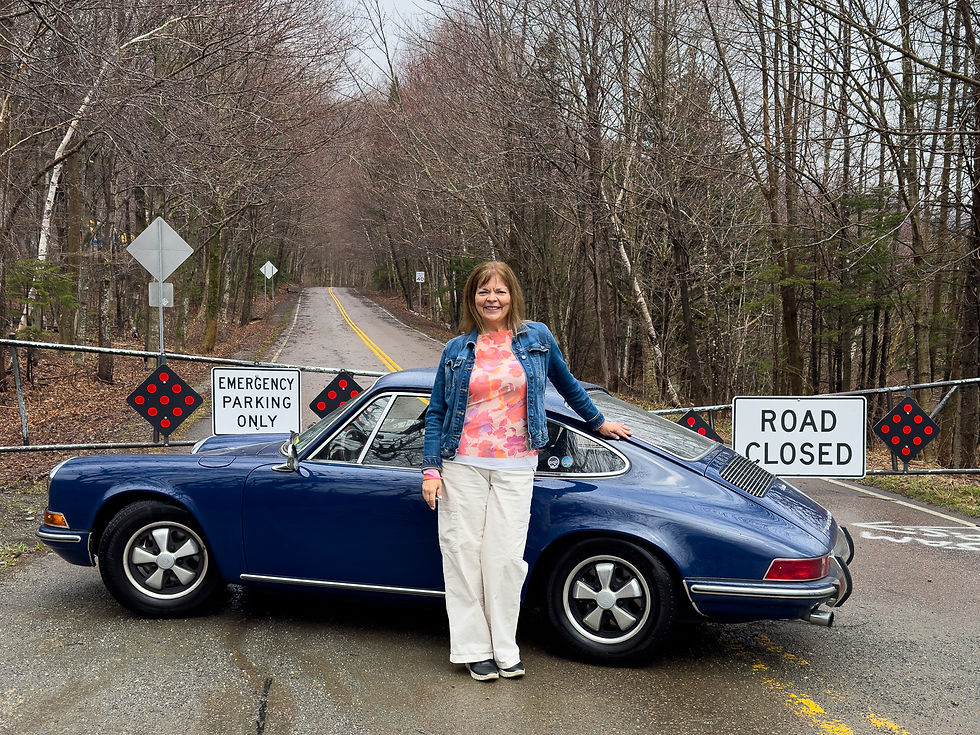
I have a start date! On February 15, 2026, I will board a plane in Boston and if all goes well, I will meet up with the Blue Car in Le Havre, France two days later. Exactly six months from today.
Now that I have set the start date, the trip feels very real. It’s been a circuitous route to get this far. With so many variables and moving parts, planning this trip has felt like moving on the constantly shifting staircase at Hogwarts. Instead of tracing my finger along the lines on a map, I am Harry Potter, facing unexpected blank walls and unknown corridors at the whim of the shifting treads and risers.
When I started preparing for this road trip, I had a framework that guided all my choices and decisions:
I am not driving the Blue Car in hot weather. Full stop. Read “The Blue Car and the Trees” if you want a recap of how miserable I am driving in high temperatures and humid conditions. I have always assumed I would do this road trip from late winter to the beginning of summer, starting in the south and working my way north as the days get longer and hotter. After originally considering starting in France, I decided I would ship the Blue Car to the Port of Sines in Portugal, allowing me to get right on the southern itinerary while the weather is still cool.
When this trip was still just a glimmer of an idea, I decided this European adventure would be longer than my cross-country road trip--four or five months. The effort and cost to get the Blue Car to Europe should be worthwhile, amortized over many weeks on the road.
I am a social person and don’t mind being in a crowd. Put me in a sea of people for a Central Park concert? Pack me on a rush hour train in Tokyo? I can handle these things without a blink of the eye. But driving or walking on packed streets in Europe during the height of tourist season? Make me wait in line for two hours to get into Giverny only to have people shove selfie sticks in my face while I try to enjoy Monet’s gardens? No thank you. I want to be in Europe and back again before tourist season is in full swing.
Budget is the easiest. Over the course of my adult life, I have traveled at all budget levels. Hostels, friend’s sofas, boarding houses with shared bathrooms two levels down. Italian sheets, resorts, downtown hotels with nightly jazz in the lobby bar. I am resourceful. I can adapt my trip, lodging, and itinerary to meet my bank account.
I have assumed, since I first considered doing this trip, that I will drive the length of Italy to the boot and back. I lived in Tuscany many years ago when my kids were just 2, 7 and 13. We were anchored to one place for that year because of their school schedules (although of course I took them to Lake Como for the Concorso d'Eleganza Villa d'Este!). There is so much more I want to see and do! And I want to brush up on my Italian (which never got beyond basic communication).
I have never questioned that I would do the Alpen Passes, traveling for two weeks in Switzerland, Italy, and France and combining epic drives, including the famed Stelvio Pass, with stops for day hikes.
As a U.S. citizen, I am only allowed to be in the European Union/Schengen area for 90 days within a 180-day period. I can’t simply leave and come back in to reset the clock. But I have assumed I can get a longer-stay visa or digital nomad visa to extend my trip…
…and that’s where I came to the first challenge in planning.
Extending my time in the European Union isn’t easy. Yes, if I want to stay in one country such as Portugal or Italy, I can lease an apartment and apply for a digital nomad visa. But that means being tied to one place and the digital nomad visa doesn’t allow me to travel beyond the 90-day time limit in other European Union countries. It looked like my trip would be three months unless I added non-E.U. countries which weren’t on my original itinerary.
Then other challenges popped up.
I can’t start and complete my trip before the heat of summer and the height of tourist season AND drive the passes of the Alps. Those Michelin Maps I purchased back in March are quite clear…many of those passes are still snow-filled well into June. A Porsche owner recently sent me a photo of a group road trip in early July showing cars covered in snow in a sudden storm. The best time to drive the Alps for reduced risk of snow? Mid-July through September, long after I plan to be back home again.
And then a quick check with my shipper revealed the unwelcome news that shipping from Port Newark to Portugal is over three times the cost of sending the Blue Car to France, my original planned destination. That doesn’t work for my budget.
It was at this point that the terms “roadblocks” and “detours” came unbidden into my mind. After all, when we can’t do what we plan, it can feel like everything just stops, that we have reached an impassable barrier in the road. And I had certainly hit some barriers. The Alps weren’t going to be possible if I wanted to avoid tourist season and possible heat waves. I couldn’t stay more than three months. And I needed to rework my itinerary to start in France, not Portugal.
Roadblocks and detours.
The words we use matter; they are encoded with a lifetime of associations, memories, and meaning. The words we use determine how we approach challenges, look danger in the face, and react when we meet those barriers in the road. As my assumptions and expectations shifted from under me, I quickly came to realize that as fun as they were (I am planning a road trip after all) the words “roadblocks” and “detours” weren’t useful; maybe I should think about “constraints” and “new possibilities” instead. Why the shift? I know a lot about constraints.
When I studied architecture in college, I regularly wished for assignments that gave me free reign over all the design decisions. How much more fun it would be to design without size and site constraints! Then, when I was fresh out of school and in practice, I would lament the zoning and building code restrictions, site limitations, and budgets that held me back from doing my best work. These constraints were annoying roadblocks to my creativity. If only I could do x, or spend y, or ignore z!
It took me a few years and hours and hours at the drawing board to realize that these project constraints were the whole point; they unlocked the best of my creativity and called all my expertise into play. I came to understand that it’s so much more interesting to work with constraints than to be given an open map to go anywhere and do anything.
I don’t think life is any different than those design projects. A roadblock is simply a constraint that offers an opportunity. It forces detours, it implores us to search out alternative routes. And if one is willing to go down these alternative routes with an open mind rather than dwelling on the road that is blocked, these new routes can offer possibilities never imagined.
So…I thought about how to work within these new road trip constraints and realized it might be useful to take a big deep breath and start from scratch. It might be easiest to question everything I had assumed and expected. One day in architecture school, I walked into my Materials Class with a balsa-wood model of my bus shelter design, and the professor took the model from my hands and turned it sideways 90 degrees. I remember the shock and awe I felt when I saw it looked and functioned so much better. It took a fresh set of eyes and a bit of whimsy and cheek on the part of my professor to reveal things in a new way.
So…I turned everything I expected and assumed about my road trip sideways and upside down. I asked myself, “If you were starting from scratch, now that you know what you can and can’t do, where would you go and when?”
The answers came surprisingly easily when I let go of my initial expectations and embraced all the possibilities. When I gave up my assumptions. My start date is set, I have a revised general route, and it doesn’t look at all like my first plan.
Gone is my month of driving the length of Italy, circling the country. Portugal is also out and so are the Alpine Passes. I may do northern Spain, and I may not. I am back to shipping the car to Le Havre and starting the trip exploring France. I have kept at least four weeks in Germany and a visit to the Porsche Factory (of course).
I have added the U.K. to the itinerary. It isn't in the EU any longer, and I can spend five or six weeks there in May exploring gardens, farms, and small towns without cutting into my 90-day limit for the Schengen area.
I have also added Scandinavia. I will visit Denmark where I spent a college semester studying architecture and will then head north to the UNESCO World Heritage mountain town of Røros, Norway where I created and led a study abroad program for two summers when my oldest child was a toddler. And then, new territory! I will drive north to the Arctic Circle where I will celebrate the summer solstice, returning back through Sweden and Denmark to ship the Blue Car home from Germany.
I never would have thought of the Arctic Circle before my decision to skip Italy. And I was dead set on at least a month in Italy until my trip time got reduced to 90 days. Did I really want to spend a month in a country I had lived in for a year? The tighter time frame also forced me to hold true to my original intent to travel slowly and to avoid the temptation to breeze in and out of towns and cities to cover as much ground as possible. And I am excited about driving through the countryside of England, Wales, and possibly Scotland, places not originally on my itinerary.
As for those Alpine Passes and Italy, Portugal, and Spain? The thing about constraints is that they usually involve compromise. They force you to think about what’s important. You give away something to get something. You find a different way…a detour. A new possibility. Maybe this upcoming road trip is the trip of a lifetime. Or maybe there is more than one road trip of a lifetime waiting for me. I would like to think so. If things go well, maybe I can return, in late August of 2027, to start in the Alps and then head south as the weather gets cold to explore Portugal, Spain, and Italy, coming home in November.
Two trips to Europe with the Blue Car! It seems like a lot to ask. Maybe it will happen and maybe it won’t. No one can have everything, and I sure have more than I ever expected. I know I am privileged and oh so lucky. That’s enough to make me grateful and content, no matter what this coming trip holds.


Comments